
Charade Quilt Along: Tips for Laying Out Your Blocks Like a Pro

If you're working through the Charade quilt pattern right now, this post — and the video above — are for you. Mitzie walks through the whole process in the video, but here are the key things to keep in your back pocket as you sew.
Start with your cutting order
Before you cut a single strip, remember this: cut E first, then D, C, B, and your three A's last. If you cut in the other direction and your fabric runs a little narrow, you'll lose your E piece. That's the biggest piece in the block. Protect it first.
Every block needs the same pieces
Each block contains three A's, one B, one C, one D, and one E. How you arrange them has some flexibility; Mitzie even discovered mid-project that she'd inverted two pieces on every single block, and it still worked beautifully. The controlled improv is forgiving. Don't overthink the arrangement; focus on making sure all the pieces are there.
Random order isn't actually random
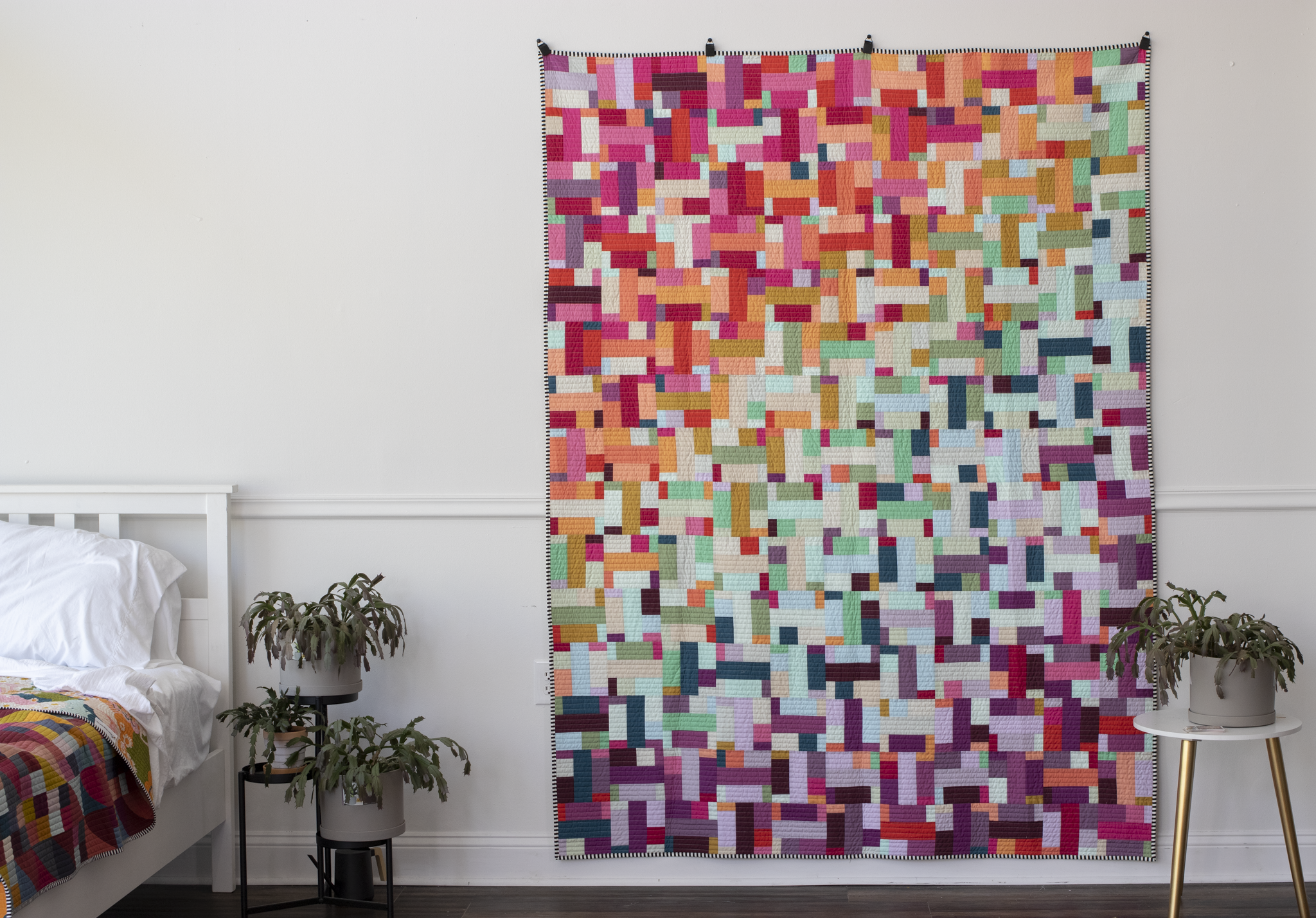
This is the thing that surprises most quilters: the "random" version still uses value intentionally. Sort your finished blocks lightest to darkest. Then start placing your lightest blocks first, clustered slightly off-center. Use up ALL your lights before you touch the mediums. Use up all your mediums before you touch the darks. Work outward organically, not in a square, so your darkest blocks end up around the edges. It'll feel wrong when only the lights are up. Trust the process.
Rainbow order is about E and D
For the rainbow version, your B and C pieces should come from the same color family (or adjacent ones), but the real color story is told by E and D, they're the biggest pieces and carry the most visual weight. Sort your blocks in ROYGBIV order based primarily on those two pieces. Don't have a color? Skip it. Move on. The gradient will still read.
Always check your E block direction
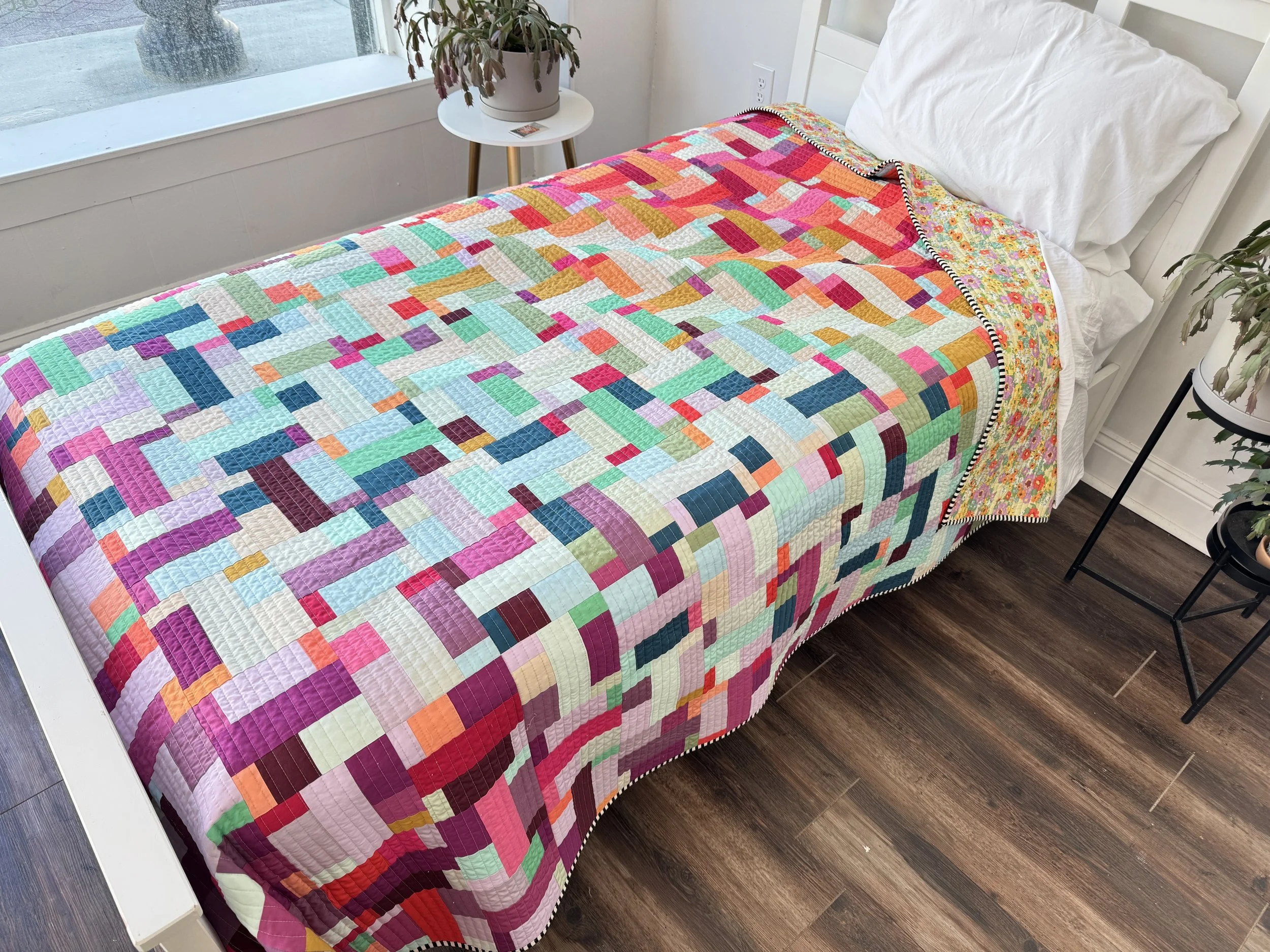
At the end of your layout session, go back and check that your E blocks alternate direction: one this way, one that way, all the way through. Mitzie admits she has to do this every single time. You probably will too.
Come show us your layout
The best place to get eyes on your fabric pull, your block arrangement, or any question that's stumping you is Hive+, our quilting community. Post a photo, ask a question, and you'll hear from Mitzie and from quilters who've already finished their Charade quilts. It's encouraging, it's helpful, and it's exactly where you want to be mid-quilt-along.

This colorful improv quilt uses scraps of all sizes, Jelly Rolls, Fat Quarters, or yardage. It uses a “controlled improv” method, meaning you will have a plan and boundaries to help it flow even if you feel improv is difficult.
Materials
Choose from solids, blenders, & small print fabrics that don’t include contrasting spots, lines, or objects. Each piece should read a single color after cut to size.
NOTES ON COLORS & FABRICS
A “Color” would be a light blue, a dark yellow, or a medium purple.
A Color Group is “all” Blues or “all” Purples. (ROY G BIV)
You may need different fabrics to equal a single “color” when using scraps.
You may have all the ROY G BIV color groups in your quilt or just a couple, like Y (yellow) and G (green). If you only have Y and G, you should have lights to darks for each color group.
Regardless of the number of color groups, you need a variety of lights and darks in your quilt.
Video Tutorials Found here.