
Color Theory for Controlled Improv
This tutorial was updated June 2024 to help better answer the questions I get about color.

The First Time I Tired Improv Quilting was a Disaster
The first time - let’s be honest, the first couple of times - I tried improv quilting, and it was a disaster. I was told to “just start with no plan and keep adding to it, and it will be glorious.” Okay, maybe they didn’t use the word glorious, but quilty friends, each attempt was a serious disaster. There was nothing glorious about it. Each time I tried, I threw away the project and felt guilty for wasting time and fabric.
Looking back, I consider it all “tuition” for developing my own method of what I have come to call “controlled improv.” When I use this term, I mean that by applying design elements found in nature to the “boundaries” or “parameters” I intend to work inside for the improv piece, I end up with a quilt that my brain sees as natural, normal, or coordinated. So, maybe I don’t have an actual plan, but I do have boundaries. The first boundary to consider for me is always color.
This post includes tips and images to help you make color decisions for your controlled improv quilts. This is great for any of my patterns, like All the Good, Golden Eye, Silas Pew, and Caper. It also works if you’d like to design your own.
Start with a Pile of Fabrics
Step 1: Begin by laying all the fabrics out so you can see them. It is quite likely they will not look like they work well together. At this point, don’t try to arrange them in any sort of order—simply lay them all out so you can see them.
TIP 1: Either snip a little corner from each fabric so you can easily move them around, or if you are using fat quarters or something smaller, fold them all to a similar size.
TIP 2: It is helpful to lay your fabrics on something white so the background doesn’t alter the appearance of the fabric color. You need a space large enough to move the fabrics around.
Color Confessions + ROY G BIV
Okay, friends, this is a total confession. I spent a long time avoiding the color wheel because I didn’t understand it. All that monochromatic, analogous, complementary, triad, split complementary, and tetradic never made sense to me. I think it was because I could never see the colors on the wheel next to each other. I am honestly not sure why, but I still avoid it to this day.
I now Think of Color in a Line
Instead of the color wheel, I like to think about color in a line representing the rainbow. Most of us learned ROY G BIV in grade school. It stands for red, orange, yellow, green, blue, indigo, and violet. This is something that occurs in nature repeatedly, so our brains recognize a rainbow as natural.
Step 2: Designate a space on your table where each color family may be placed in order of ROY G BIV. Then, as shown in the image below, begin making little piles of fabrics by the color of the rainbow. If you have neutrals like whites, browns, greys, or blacks, put them in their own piles.

The Next Natural Design Element
After placing fabrics in ROY G BIV order, the next natural design element I like to use when thinking about color theory is moving from color to color in a light to dark - dark to light - light to dark - dark to light pattern. If you think about the petal of a flower that has two colors in it, it doesn’t just “transition.” The line of color change isn’t harsh, it is fluid and the colors blend together until one color disappears.
Step 3: Think of your colors individually as families. Within each family (ROY G BIV), begin lining them up with dark at the top and moving down to the lighter fabrics in that color family. You can see this in the image below.
Identifying Colors that Don’t Work
It is much easier to find the colors that don’t work when you do this. Because of how designers make their color palettes for fabrics, there may be a green with more yellow and a green with more purple in it. This can often make these two greens “clash.” Remove any colors that don’t work at this point.
NOTE: It doesn’t matter how many ROY G BIV color families are represented. Once you begin to place them on the line, your brain should begin to recognize them as more natural. They should “feel better” to you instantly. Maybe not perfect, but definitely better than when they were all laying out on the table in no apparent order.

Step 4: After you have each color in dark-to-light order, take your first color family and lay it out from dark to light in a row. Then, take the next color family in your palette and reverse it. Lay it out from light to dark. Then, the third goes dark to light. You repeat this all the way to the end of the line. This is shown in the image below.
THE GOAL: The goal is not to have “harsh” transitions with very dark and light fabrics right next to each other. While that is fine for many quilts, it is disruptive to the eye for a quilt with a lot of color and flow.
TIP 3: After getting started, you may realize you only have a single fabric for one color family, and it is light. That means the color before it must “end” in light or medium, and the color that comes after it must “start” in medium or light. This may cause you to reverse color families by working backward.

Adding Neutral Fabrics
Step 5: Decide where in your line the neutrals will be placed. I tend to like them offset from the center. They need to flow through your light-to-dark and dark-to-light pattern without disrupting the eye.
TIP 4: Most neutrals include a hint of one of the ROY G BIV colors. If that is the case, keeping them close to that primary color will be important so your brain reads them as natural.

Breaking the Line
In a quilt design that needs a gradient of color, you don’t always have to start with R (red). You can actually “circle” your line around so that your colors are all in order of the color wheel, and then you break it at any point to begin.
Step 6: Decide which color you want to start the flow of your ROY G BIV. Then, “break” the circle and straighten all your colors out into a line, keeping them in order.

Deciding on Your Final Color Options
Step 7: Getting all your fabrics in ROY G BIV color flow order is the best way to help ensure they all work together. After this, you can decide to simply keep them in this order for the quilt top or make use a completely random color placement option. Because the fabrics work together in ROY G BIV flow order, they will also work in random order.
To make a flowing rainbow quilt:
I like to lay out all the pieces for a single block in order and then slide them down to begin matching the total pieces for the block. I keep most of them in order and circle the last color back to the start of the row. I like to select 5 to 7 of the matches randomly to add some pop.
To make a completely random quilt:
I make piles of the pieces I need for a single block and just grab them randomly without much thought to it as long as I am not repeating fabrics in a single block.

You Can Do This
You can do this. Just take your time and lay out your fabrics while following the tutorial. You Got This! I have lots of videos and tutorials for each of of my controlled improv patterns. Look under “Quilt Alongs” above for support on the pattern you are making. I also have a Facebook Community that provides support + encouragement.
Patterns that Use This Process
Most of my patterns use this process. You can explore those here on the website.
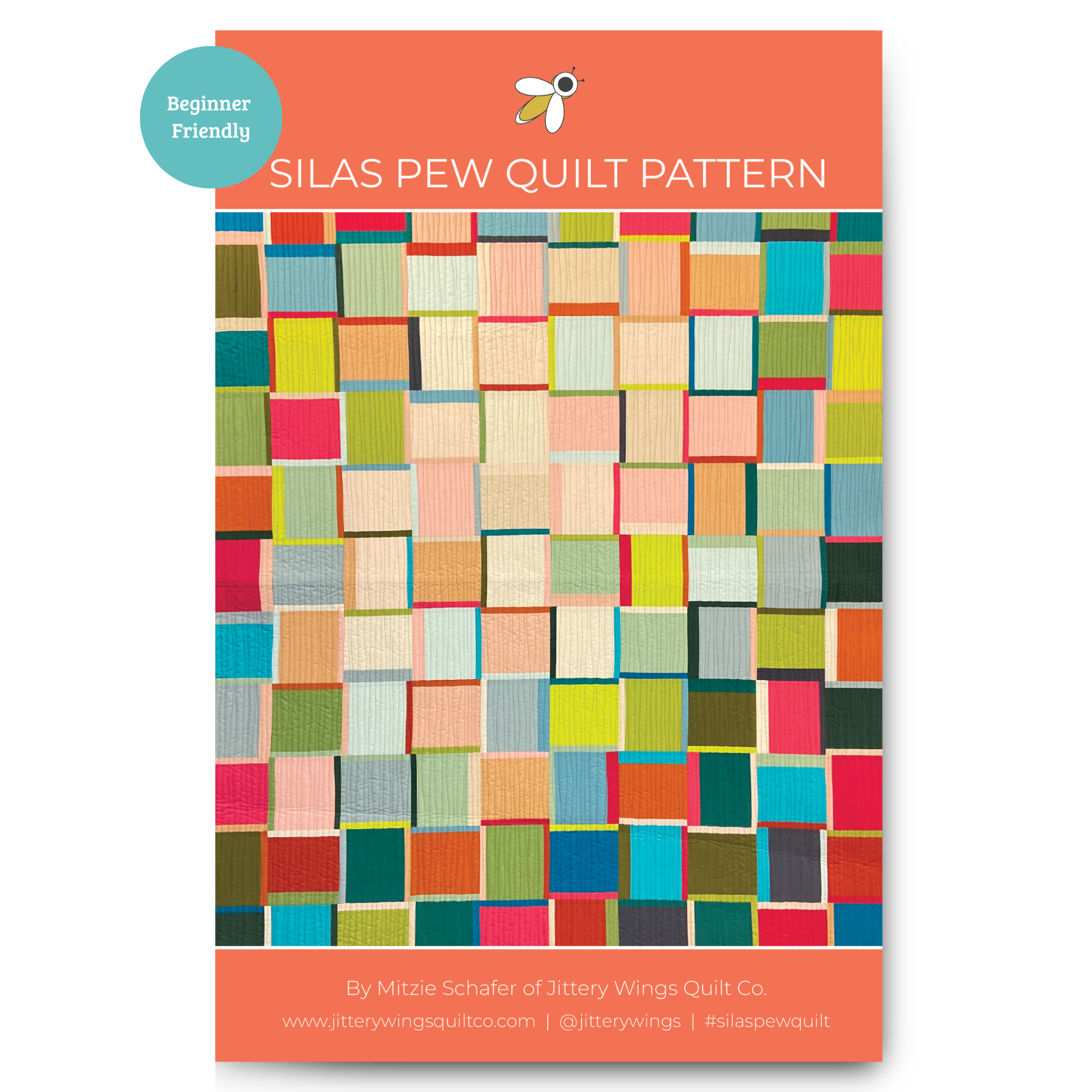
The Silas Pew Quilt Pattern uses scraps, fat quarters, or even yardage for a big impact. It is simple to sew, beginner-friendly, and maximizes movement with a rotating block.
ADDITIONAL NOTES ON SELECTING COLORS & FABRICS INSIDE
Choose from solids, blenders, and small print fabrics that don’t include contrasting spots, lines, or objects.
After being cut to size, each piece should read as a single color.
Note: Fabric bundle #2 in our shop was used for the image coverstock quilt and bundle #7 is the brightly colored quilt shown. You can purchase either bundle in our shop!

This fat quarter friendly pattern uses the entire fat quarter with no waste. It also uses the Eight-at-a-time half square triangle method to avoid bias and wonky triangles. This pattern uses my method of controlled improv: you can arrange your blocks and colors in countless ways, but the pattern will walk you thought some key options.
Materials:
Baby: 12 Fat Quarters
Throw: 24 Fat Quarters
Queen: 52 Fat Quarters
Choose from solids, blenders, and small print fabrics.
**** Got your pattern? Now follow along with us step-by-step and learn some tricks and tips on our sew along series


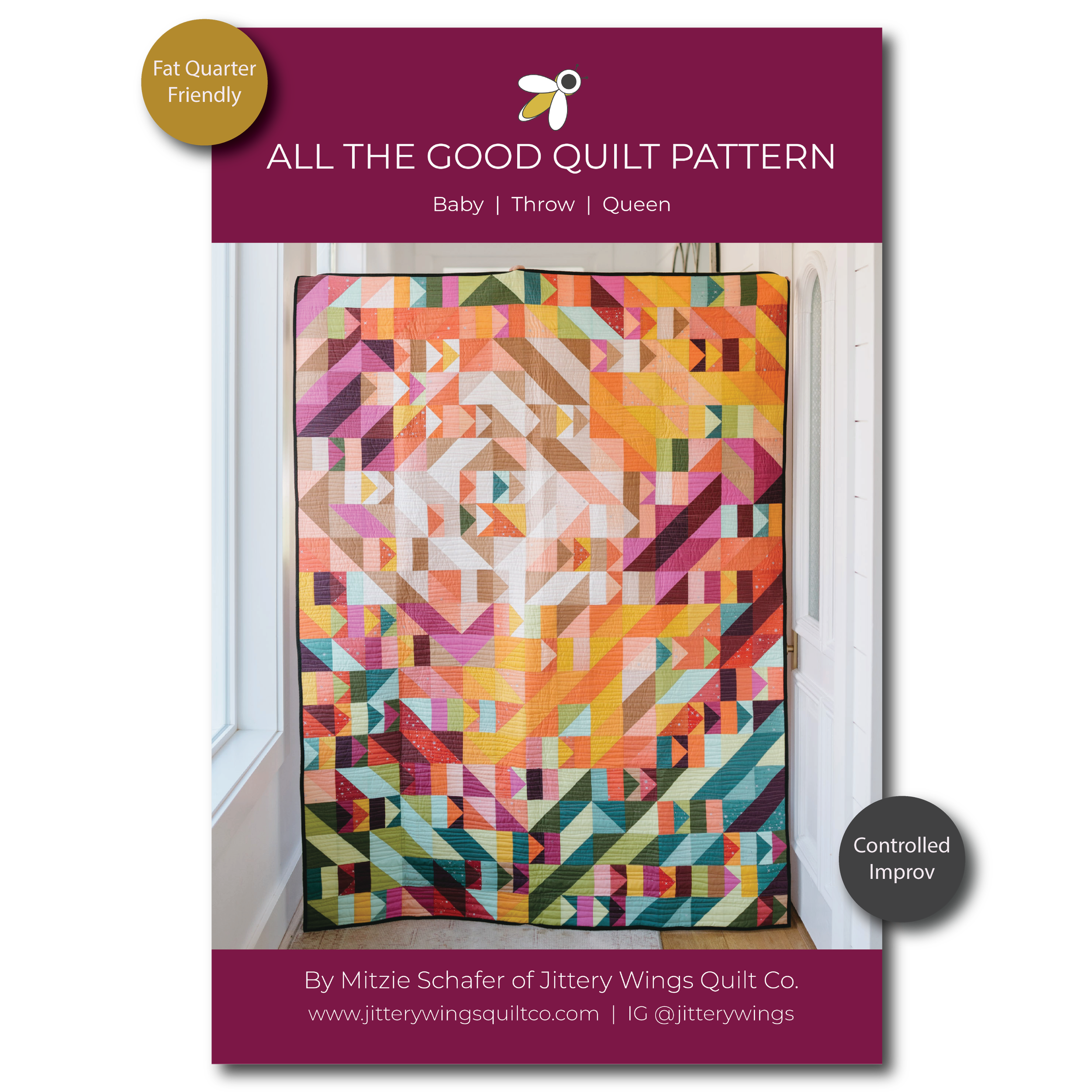
COMPLETELY FAT QUARTER FRIENDLY!
This quilt is designed to use Fat Quarters (FQ) with minimal waste. This is a “controlled improv” quilt pattern by nature but utilizes a system of “controlled freedom” for those who fear improv. The finished square is 4” sewn into the quilt. The pattern comes together very quickly because it utilizes the 8 at a time Half Square Triangle (HST) method and the 4 at a time Flying Geese (FG) method. Pattern is written for three sizes:
Baby: 48” x 48” - 12 FQs
Throw: 64” x 72” - 24 FQs
Queen: 96” x 104” - 52 FQs
FEATURES:
- Large technical illustrations for the visual learner and detailed written instructions for the reader types.
MATERIALS:
Baby: 12 Fat Quarters
Backing: 3 yards
Binding: ½ yard
Batting: 52” square for domestic, add 4” to each side for longarm.
Throw: 24 Fat Quarters
Backing: 5 yards
Binding: ¾ yard
Batting: 68” x 76” for domestic, add 4” to each side for longarm.
Queen: 52 Fat Quarters
Backing: 10 ½ yards
Binding: ¾ yard
Batting: 100” x 108” for domestic, add 4” to each side for longarm.
NOTE: Some of your Fat Quarters can be the same fabric, but that is not required.
**** Got your pattern? Now follow along with us step-by-step and learn some tricks and tips on our sew along series

This colorful improv quilt uses scraps of all sizes, Jelly Rolls, Fat Quarters, or yardage. It uses a “controlled improv” method, meaning you will have a plan and boundaries to help it flow even if you feel improv is difficult.
Materials
Choose from solids, blenders, & small print fabrics that don’t include contrasting spots, lines, or objects. Each piece should read a single color after cut to size.
NOTES ON COLORS & FABRICS
A “Color” would be a light blue, a dark yellow, or a medium purple.
A Color Group is “all” Blues or “all” Purples. (ROY G BIV)
You may need different fabrics to equal a single “color” when using scraps.
You may have all the ROY G BIV color groups in your quilt or just a couple, like Y (yellow) and G (green). If you only have Y and G, you should have lights to darks for each color group.
Regardless of the number of color groups, you need a variety of lights and darks in your quilt.
Video Tutorials Found here.

